

What Is The United States Racial Makeup
As the U.S. population becomes more racially and ethnically diverse, Americans have mixed views almost how the country might modify when blacks, Hispanics, Asians and other minorities make upwards a bulk of the population. While more say this change will be skilful for the state than say it will exist bad, the predominant view is that it will be neither.
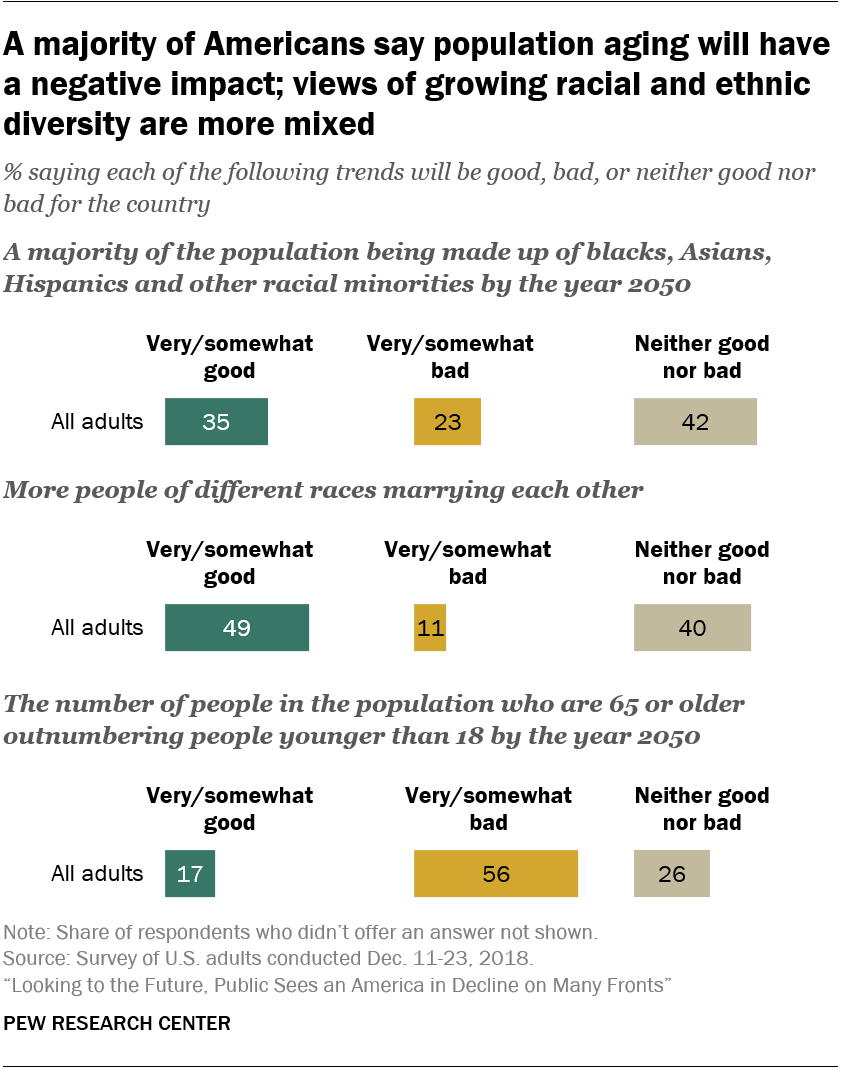 At the aforementioned time, when asked about projections by the U.Due south. Census Bureau that a bulk of the U.S. population will be nonwhite by the year 2050, about half of Americans say this shift will lead to more conflicts between racial and ethnic groups. And about 4-in-x predict that a majority nonwhite population will weaken American community and values, larger than the shares who say information technology volition strengthen them (30%) or will non have much of an impact (31%).
Opinions about the growth in interracial marriage are, on residuum, positive or neutral. About one-half say more people of unlike races marrying each other than in the past is a somewhat or very good thing for the country, while most one-in-10 say it'south a somewhat or very bad affair, and four-in-ten run into this as neither good nor bad. On this question, too as the questions most the impact of having a bulk nonwhite population, Democrats and those who lean Democratic express far more positive views than Republicans and Republican leaners.
The survey also asked most trends related to wedlock and divorce. Most one-half of Americans (53%) predict that in 30 years people will be less likely to get married than they are now; just 7% say people will exist more than likely to get married, and 39% say people volition be well-nigh equally probable to marry. About vi-in-ten await the divorce rate to remain about the aforementioned, but 29% say people who are married will be more than likely to get divorced than people are at present; 12% say married people volition be less likely to divorce.
Americans have a more negative view of another demographic tendency: the aging of the U.S. population. According to the U.Due south. Census Agency, by the year 2050, people who are 65 and older will outnumber those younger than 18, and 56% of Americans say this will take a negative affect on the land.
Americans are divided on the overall touch on of having a majority nonwhite population
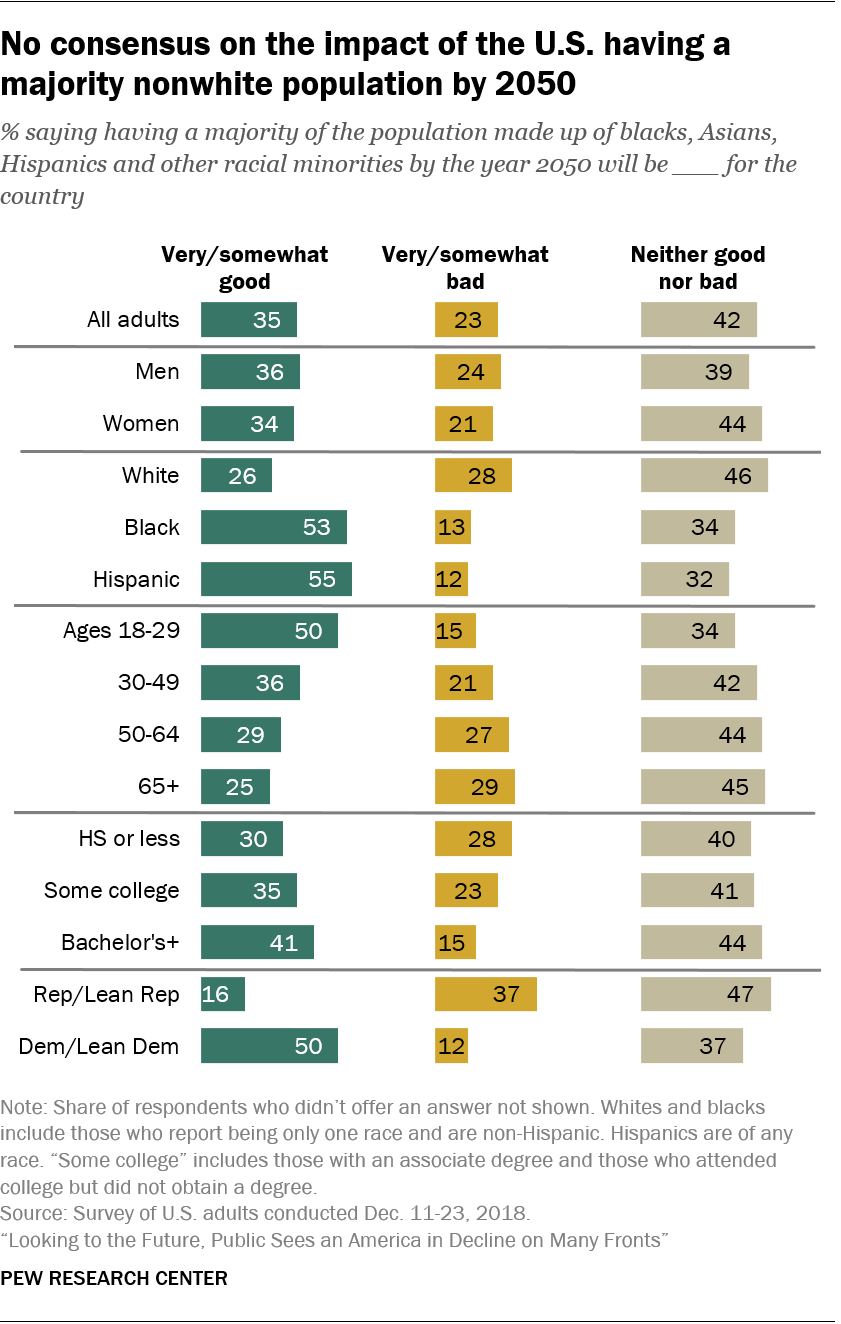
According to the U.S. Census Agency, blacks, Asians, Hispanics and other racial minorities will make up a majority of the population by the year 2050. When asked about the bear upon this modify will have on the state, well-nigh a third of adults say this volition be either very (17%) or somewhat (18%) good, near a quarter say it volition be very (15%) or somewhat (8%) bad, and 42% say this change will exist neither good nor bad.
Nonwhites are about twice as probable as whites to say having a bulk nonwhite population will exist practiced for the country: 51% of all nonwhite adults – including 53% of blacks and 55% of Hispanics – say this, compared with 26% of whites. About three-in-10 whites (28%) say this change will be bad for the country, while 46% say information technology will be neither proficient nor bad.
Views too differ by historic period. Young adults are more likely than their older counterparts to say a shift toward a majority nonwhite population volition benefit the country: 50% of adults younger than 30 hold this view, compared with 36% of those ages xxx to 49, 29% of those 50 to 64, and a quarter of adults ages 65 and older. These differences reflect, in part, the fact that the younger grouping is more racially and ethnically diverse than the older groups. Age differences in views of this projected demographic alter are more than modest among whites.
Views nigh the impact of having a majority nonwhite population also vary considerably by party. Amid Democrats and Democratic-leaning independents, one-half say this modify will have a positive touch on on the country, while 37% say it will be neither positive nor negative, and merely 12% say information technology volition have a negative bear upon. Past contrast, a larger share of Republicans and Republican leaners say this volition exist bad for the land (37%) than say it volition be good (16%), while 47% say it volition be neither skillful nor bad. These partisan differences hold upwards even afterward accounting for respondents' race and ethnicity.
About one-half of Americans say having a majority nonwhite population volition lead to more than racial and ethnic conflicts
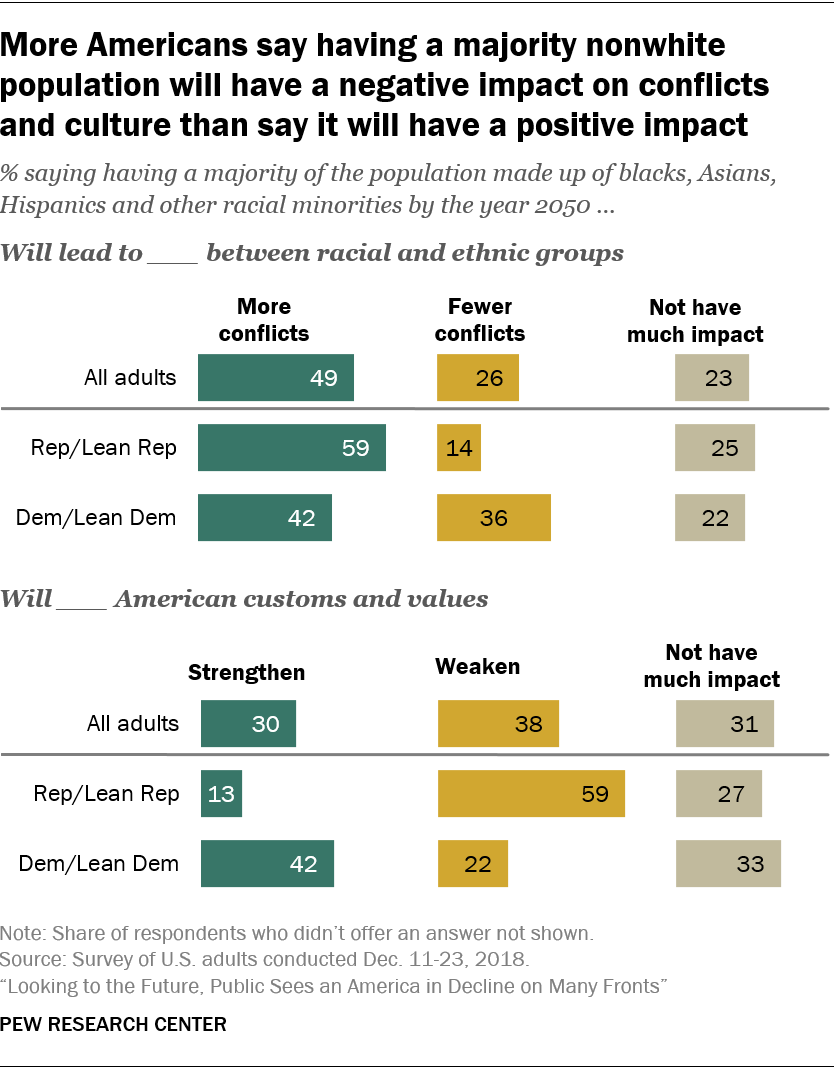 While virtually Americans say a majority nonwhite population will accept a positive or neutral impact on the country, more say this shift will lead to more conflicts betwixt racial and ethnic groups (49%) than say it volition lead to fewer conflicts (26%). And more than say this will weaken American customs and values (38%) than say information technology will strengthen them (30%).
Consistent with their more negative assessments of the overall impact of this demographic alter, whites are more probable than nonwhites to say having a majority nonwhite population will pb to more racial and indigenous conflicts (53% vs. 43%) and that it volition weaken American customs and values (46% vs. 24%).
Among Republicans, well-nigh 6-in-ten say having a majority nonwhite population will pb to more conflicts betwixt racial and ethnic groups and that it will weaken American customs and values (59% say each will happen). Democrats are more divided in these assessments. Nearly four-in-ten Democrats (42%) say this will lead to more racial and ethnic conflicts, 36% say it will lead to fewer conflicts and 22% say it won't have much of an bear on. And while 42% of Democrats say having a majority nonwhite population will strengthen American customs and values, sizable shares say it volition weaken them (22%) or non have much of an bear upon (33%).
Many see the rise in interracial marriages as a good thing
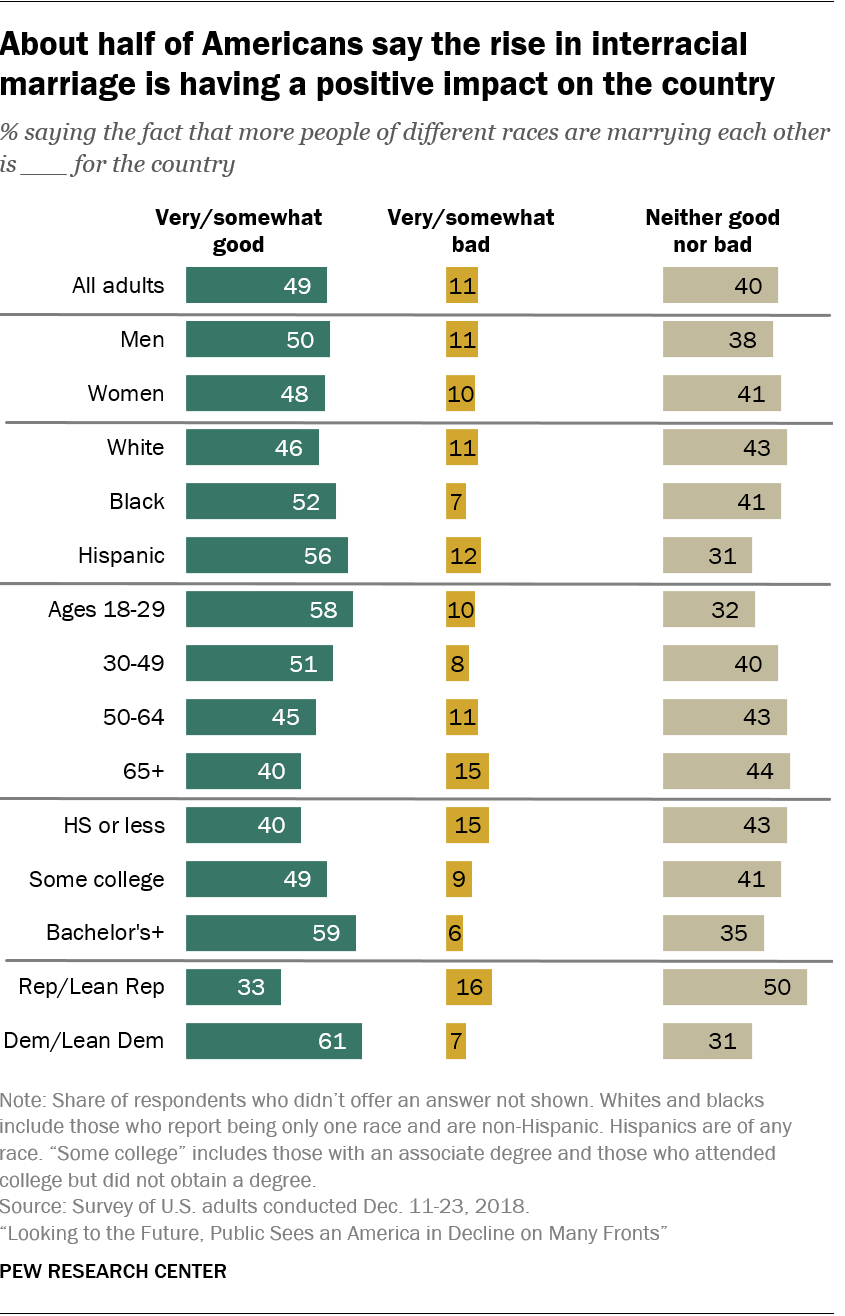 Nearly half of Americans say it's either a very (30%) or somewhat (19%) good thing that a larger share of people of different races are marrying each other than in the past; nearly one-in-ten (xi%) say this is a bad affair, and four-in-ten say information technology's neither practiced nor bad. Views on this question don't vary considerably beyond racial and ethnic groups.
A majority of adults younger than xxx (58%) run into the increase in interracial marriages positively. Among the older groups, 51% of those ages 30 to 49, 45% of those ages 50 to 64, and twoscore% of those 65 and older agree. About four-in-10 in each of the three groups say this is neither expert nor bad, while relatively few see it equally a bad affair.
Views also vary by educational attainment and political party identification. Nearly two-thirds of adults with a postgraduate caste (65%) say the ascent in interracial matrimony is a proficient matter for the country, compared with 55% of those with a available's caste, 49% of those with some higher education and 40% of adults with a high school diploma or less educational activity.
Among Democrats and Autonomous-leaning independents, about half-dozen-in-x (61%) say it's a expert affair that more than people of dissimilar races are marrying each other, and this is particularly the case among those who describe their political views every bit liberal. About three-quarters of liberal Democrats (73%) say this is a proficient thing, compared with 51% of their moderate or conservative counterparts. Only seven% of all Democrats and Democratic leaners consider the ascension in interracial wedlock to exist a bad thing, and 31% say it's neither good nor bad.
Republicans and Republican-leaning independents are less likely than Democrats to see the increase in interracial marriages in a positive mode: 33% say this is a somewhat or very good thing, while 16% see this every bit a somewhat or very bad matter, and half say information technology's neither good nor bad. At that place are no pregnant differences in the views of Republicans who consider themselves conservative and those who say they are moderate or liberal.
More than one-half of Americans wait marriage to be less mutual by 2050
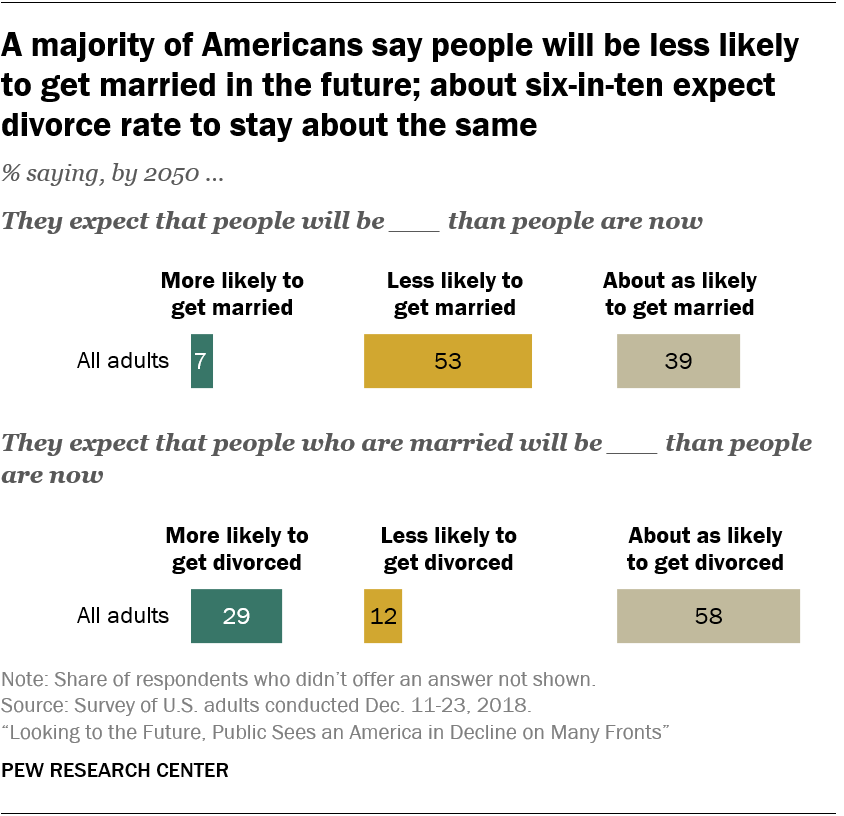 Despite a longer-term down trend, the share of U.Southward. adults who are married has been relatively stable in recent years. But almost half of Americans look that to change, with 53% maxim that people volition be less likely to get married in 2050 than they are now. Just seven% say people will be more likely to get married, while 39% expect no significant modify.
For the most office, views on the future of union don't vary much across demographic groups, but higher shares of those who are currently married (57%) than those who are not married (48%) look union to exist less common by 2050. And while 56% of whites and 53% of Hispanics expect that people volition exist less likely to get married in 2050 than they are now, just about a third of black adults (34%) say the same.
For the most office, Americans expect the divorce charge per unit to stay largely unchanged: 58% think married couples will be about as likely to get divorced by 2050 as they are now. But a sizable share (29%) call up people who are married will be more probable to become divorced in some other thirty years; 12% think divorce volition be less common by and so. Married and single people have similar views on the futurity of divorce.
Many think people will be less likely to have children
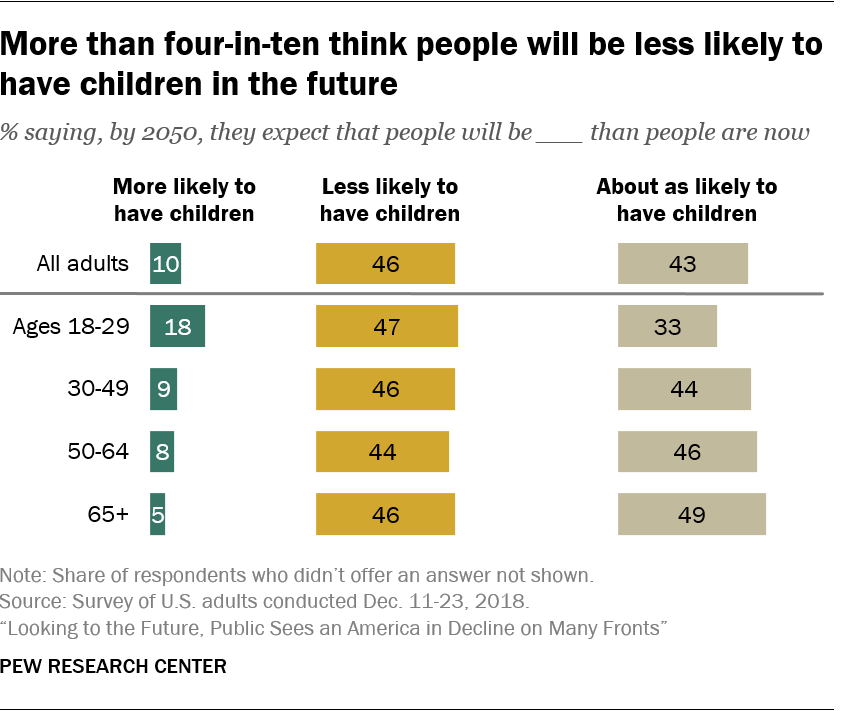 More than four-in-ten Americans (46%) wait that, by 2050, people will be less likely to take children than they are at present. A similar share (43%) think people will be about equally probable to have children, while only one-in-x expect people to be more than likely to have children in the future.
While a minority across all age groups await that people in 2050 will be more likely to have children, young adults are more probable than older Americans to say this is the case. Well-nigh one-in-five adults younger than 30 (18%) say they expect that people in 2050 will be more likely to have children, compared with 9% of adults 30 to 49, eight% of adults 50 to 64 and 5% of those 65 and older.
A majority of Americans say population crumbling will accept a negative bear on
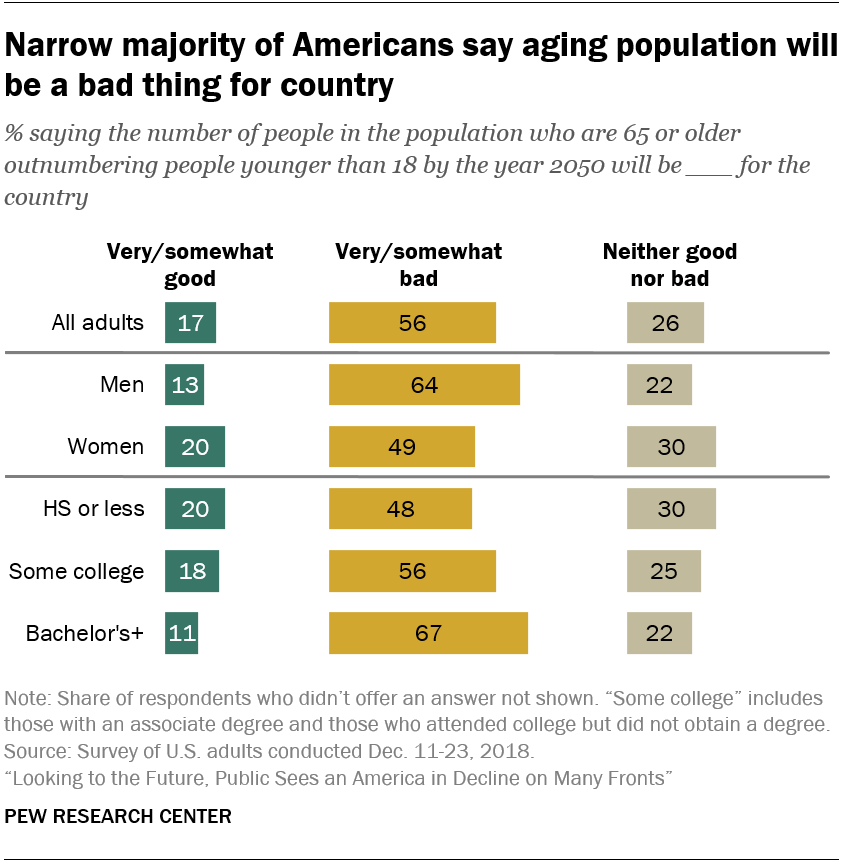
The U.Southward. Demography Bureau estimates that, by 2050, the number of people who are 65 and older will outnumber those younger than 18. A majority of the public (56%) say this transformation will be a somewhat or very bad thing for the country, 17% say it will be good and 26% say information technology will exist neither good nor bad.
Adults with more educational activity are more likely than those with less formal schooling to encounter population aging negatively. Almost ii-thirds of those with a available'south degree or more education (67%) say this will have an adverse affect on the land, compared with 56% of those with some college and 48% of loftier school graduates and those with less teaching.
Views about the impact of population crumbling besides vary considerably by gender. Men are far more than likely than women to say this change will exist bad for the country (64% vs. 49%), while 20% of women – vs. thirteen% of men – say this trend will have a positive impact. Views don't vary considerably by age, race and ethnicity, or party identification.
Source: https://www.pewresearch.org/social-trends/2019/03/21/views-of-demographic-changes-in-america/
Posted by: henleymoures.blogspot.com
0 Response to "What Is The United States Racial Makeup"
Post a Comment